


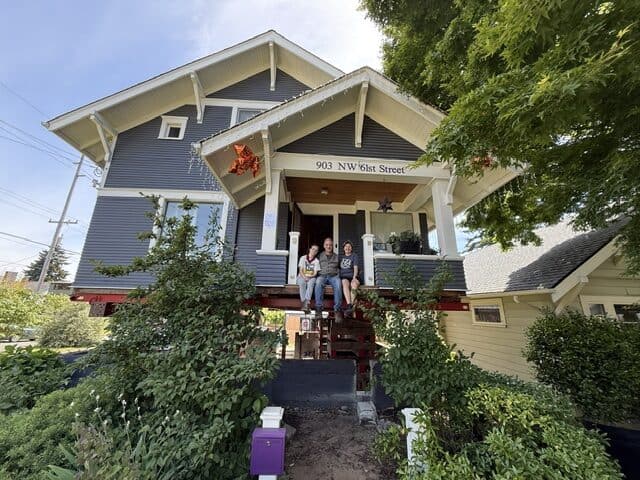
Some jobs stick with you. At Phinney Ridge Painting, we know that every home and every paint job is unique. Some more so than others. One of our most memorable and consequential projects took place a decade ago when we took a 1910 Ballard home covered in vinyl siding and restored the wood surfaces and paint to “like new” original condition. We removed old vinyl siding, stripped the failing paint down to bare wood, and worked with the homeowner to identify and repair the original trim features before completely repainting the exterior. Today the homeowners are still there, still restoring, and still happy that the paint is holding strong.
Building a Process Around What He Needed, Not Just a Price
Homeowners David & Cheri Guthrie first reached out looking for answers to difficult questions. How do we make this thing look the way it used to? How do we do it right? David isn't a typical homeowner. He's spent his career as a contractor, painting other people's homes, so he knew what questions to ask and what a real restoration requires. We built our proposal around his goals for the house, not just a number. In the process we learned a whole new way to approach exterior house painting in Seattle.
Here's how David put it:
"As a contractor, I always painted other people's homes. But when my wife, Cheri, and I decided to restore the exterior of our 1910 home, I knew I needed help. We had to take the existing vinyl off the house and rebuild all the original trim, and then repaint. I reached out to Phinney Ridge Painting originally hoping for a competitive bid for painting my house. What I got was a responsive crew that not only listened but had an interest in accomplishing the same goals as myself. PRP completely stripped all the old paint off and painted it anew. I'm so glad we had them do it. It's been 10 years since we had the work done, and the paint job still looks as good as ever."
That's the job in a nutshell: this wasn't a repaint over existing vinyl siding (which can be done). Our crew removed the old 1980’s vinyl planks covering the house and stripped the failing paint down to bare wood on every single cedar lap board, trim face and fascia. Then we worked hand in hand with David to identify exactly which sections of trim needed to be repaired or rebuilt before we repainted the restored exterior surfaces. David's own background as a contractor made him a great partner in that process because he was not interested in covering up problems, he wanted them fixed first. This is a level of collaboration we bring to every restoration project, not just the ones where the homeowner happens to be in the trades.
Today, we take that collaboration a step further. What used to mean coordinating between a homeowner's own repairs and our paint crew is now something we offer entirely in-house: our team includes dedicated carpenters who handle trim and siding repairs directly, providing homeowners with a one stop shop to manage and produce the entire restoration, from removal and repair through the final coat of paint.
True Restoration: A Labor of Love
What makes this home special isn't just the paint job. It's the decades of care that came before and after it. David and Cheri bought the house in 1998 and have spent years since then peeling back layers of past renovations to bring the original character back. They've carefully removed interior trim, stripped and refinished it, and reinstalled architectural details that had been lost over time, like a pass-through between the living and dining rooms and pocket doors near the entryway.
Their restoration work earned the home a spot on the Ballard Classic Home Tour, where hundreds of visitors got to walk through it. And the home's story was featured in My Ballard's coverage of the couple's decades-long preservation effort, which highlighted their most recent chapter: converting the basement into a mother-in-law apartment while updating the main-floor kitchen and bathroom.
Through all of that ongoing work, the exterior we repainted over ten years ago has kept holding its own, proof that a proper strip and restore job isn't just about how a house looks the day the crew leaves. It's about how it looks a decade later, through everything mother nature puts it through in between.
Is a Full Surface Restoration Really Necessary After Removing Artificial Siding?
The short answer is yes.
Many older Seattle homes have their original old-growth cedar or fir siding hidden beneath layers of mid-century vinyl, aluminum, or even asbestos siding. Discovering those original wood surfaces is exciting—but it can also create a costly trap if you don't understand what you're looking at.
Artificial Siding: The Time Capsule Effect
For decades, the original wood and paint have been protected from the elements. They've been shielded from the sun, rain, wind, and the daily cycles of expansion and contraction caused by changing temperatures and humidity.
Because of this, homeowners are often surprised by how good the wood and old paint look once the artificial siding is removed. In many cases, the original cedar or fir is remarkably well preserved.
The paint, however, is a different story.
While it may appear solid and well-adhered, those coatings are often 50 to 100 years old. They have become brittle with age and were never designed to perform under modern exterior conditions after decades of being encapsulated.
Why Painting Over the Existing Coating Is a Mistake
Once the original siding is exposed, it begins experiencing weather for the first time in decades. The wood starts expanding and contracting with changes in temperature and moisture, placing stress on the old paint film.
Modern acrylic paints are flexible. Ancient paint is not.
If new paint is applied over those old, brittle coatings, the weakened layers underneath often fail first. The result can be bubbling, peeling, and widespread delamination—sometimes within days, weeks, or months of completing what appeared to be a successful paint job.
Ironically, the wood itself may be in excellent condition, but even when the old paint looks decent, it simply can't be trusted.

The Difference Between a Paint Job and a Surface Restoration
This is where a true exterior restoration separates itself from a quick repaint.
A lasting restoration requires:
- Complete removal of the old paint.
- Sanding the wood to create a sound surface.
- Priming the bare wood.
- Proper caulking of joints and gaps.
- Two finish coats of premium, lifetime-grade exterior paint.
Each step builds on the one before it. Skip the surface preparation, and even the best paint cannot compensate for a failing foundation.
A Lesson Learned
We learned this lesson the hard way during our early attempts at restoration work. Thankfully, that experience happened before we met David and Cheri and restored their home and we were able to apply our learning to improve their home and the direction of our business.
Their project was approached the right way—from bare wood to a fully restored finish—and the results speak for themselves.
When restoring historic wood siding, preserving the wood is only half the job. Ensuring the new coating system has a sound foundation is what determines whether the project lasts for decades or begins failing almost immediately.
That's why, when artificial siding comes off, a full surface restoration isn't an upsell—it's the only reliable way to protect the investment.
Frequently Asked Questions
How long does a full service restoration last on an older home? A properly done full service restoration, stripping old paint down to bare wood, repairing damaged trim, and applying the right primer and topcoat, can easily hold up for 15-20 years, depending on the home's exposure and the quality of materials used.
What's the difference between a repaint and a full strip and restore?
Learn more from our blog HERE.
Why not just call a general contractor? Phinney Ridge Painting is a fully licensed bonded general contractor. We specialize in repairing and restoring existing building materials, including trim, siding, windows, and doors. BUT we do not hire out our services to sub-contractors. We self-perform all work on site with our own dedicated full time, EPA Lead Certified Paint and Carpentry crews.
Does Phinney Ridge Painting handle carpentry repairs like rebuilding trim? Yes. Phinney Ridge Painting offers trim, siding, and window repair as an in-house service through a dedicated team of carpenters, so homeowners can have removal, repair, and repainting handled by a single crew rather than coordinating separate contractors.
Is it worth removing artificial siding from an old house to restore the original exterior? Often, yes. It depends on your desired outcome and goals. Reach out to us to learn more. We also paint over artificial siding, so it depends on what the client is looking for and what they want to invest towards those goals.
What tools are used for a full strip repaint? Paint shavers and similar mechanical stripping tools are commonly used to remove failing paint down to bare wood without damaging the underlying material, allowing for proper repair and a fresh coating system to be applied. We use Festool sanders and vacuums, HEPA Filtration and containment. All tools we use are EPA Lead Safe certified.
Have an Older Home With Character Worth Preserving?
If your home has original trim or siding hiding under newer materials, it might be a better candidate for restoration than replacement. Reach out to Phinney Ridge Painting for a look at what's underneath. We'll tell you honestly what we find and what it would take to bring it back.
Source: David Guthrie's account of the home's history and ongoing restoration is drawn in part from My Ballard's June 2026 article on the Guthrie family's preservation efforts.

Related Posts
Lorem ipsum dolor sit amet, consectetur adipiscing elit.

